

My Tips For Buying Them
You can buy crab legs at most grocery stores, but I usually get better quality from my local fishmonger. What’s available often depends on where you live. If you have more than one option, these tips will help you choose the best crab legs:
Type Of Crab:
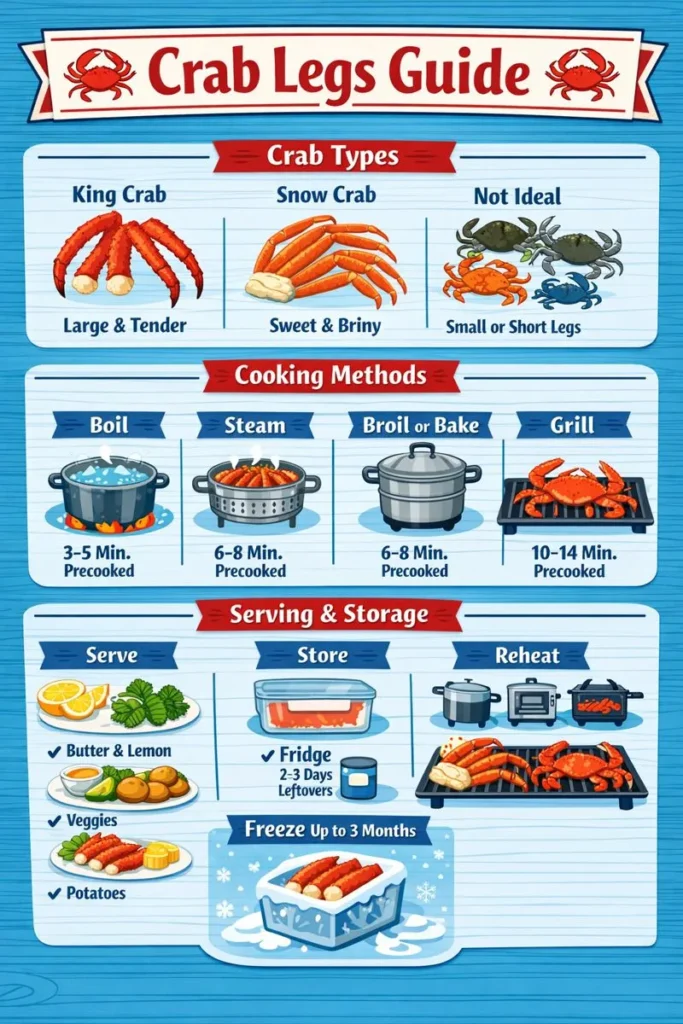
King crab legs are the best crab legs. They are the largest and most expensive option, but they have the most tender texture and the biggest, juiciest pieces of meat.
Snow crab legs are smaller, with long legs, a firm texture, and a sweet, slightly salty flavor. This is the type I usually buy (shown here) because it costs less than king crab but still comes with good-sized leg clusters.
Stone crabs, blue crabs, and Dungeness crabs are not great for my crab legs recipe. I don’t prefer them because they are either too small or have very short legs.
What Else I’ve Learned:
Most crab sold at the grocery store or fishmonger is already pre-cooked and frozen. This means most crab leg recipes are really just reheating the crab. If you ever find fresh, uncooked crab, you can use the same cooking methods, but it will take longer to cook.
You can tell if crab legs are precooked by their color. Red or orange crab legs are precooked, while gray or brown ones are raw. In my area, I almost always see red or orange crab legs.
For frozen crab legs, you can either cook them straight from frozen or thaw them first. I’ve had great results boiling or steaming them without thawing. For other cooking methods, I usually thaw them overnight in the refrigerator before cooking.
How To Cook Crab Legs
Boil:
If you have a large stockpot, boiling crab legs is the easiest way to cook a big batch. However, I find this method has less flavor because some of it escapes into the water (even if you season the water, which I recommend). Still, it’s a good option when cooking for a crowd:
- Season your cooking water. Fill a Dutch oven or large pot halfway with water. Add plenty of Old Bay Seasoning and sea salt, then bring it to a boil.
- Boil crab legs. Add the crab legs to the boiling water and simmer until heated through.
Steam:
Steamed crab legs are more flavorful than boiled ones because they don’t sit directly in the water. The downside is that you need a steamer basket, and it usually doesn’t hold many legs, so you may need to cook in batches:
- Prep your pot. Add about 1–2 inches of water to a Dutch oven and place the steamer basket inside. Make sure the basket stays above the water.
- Steam crab legs. Bring the water to a boil, add the legs to the basket, cover, and steam until hot.
Bake Or Broil:
Broiled crab legs are my favorite way to cook them because they’re quick, flavorful, and hands-off. Broiling lightly caramelizes the crab, and brushing them with butter adds even more flavor. Baked crab legs use the same method but cook at a lower temperature, so they take longer and don’t caramelize as much:
- Brush with butter. Preheat the oven and place the crab legs in a single layer on a large baking sheet. Brush with melted butter or olive oil.
- Bake or broil. Cook in the oven or under the broiler, flipping the legs halfway through.
Grill:
Grilling crab legs gives them a smoky flavor and is perfect for summer when I don’t want to heat up the kitchen:
- Brush with butter. Preheat the grill to medium-high heat and brush the legs with melted butter or oil.
- Grill. Cook the crab legs, flipping once, until they’re warm inside and lightly browned. (I used a grill pan in the photo below because it was hard to take a picture on my outdoor grill, but I tested this method on a real grill!)
My Cooking Tips & Shortcuts
- My general rule is 2 tablespoons of butter per pound of crab legs. This works well for broiling, baking, and grilling. I always serve extra butter on the side.
- If you want to steam crab legs but don’t have a steamer basket, a heat-safe colander can work. It just needs to fit inside your pot and sit above the water.
- Can you add other seasonings? Yes, but most seasonings don’t penetrate the shell unless you boil the crab legs. For other methods, I suggest seasoning the melted butter served on the side instead.
- How do you know when they are done? If your crab is precooked, they’re ready when they’re hot all the way through and smell great. If they were raw before cooking, wait until they turn bright red.
How Long To Cook Crab Legs?
Cooking time depends on the method you use, but crab legs cook quickly. The fastest methods take about 3–5 minutes, while slower methods can take up to 15–20 minutes. Raw crab will take longer. I’ve tested each method several times and created this timing chart:
| Cooking Method | Precooked Crab Legs | Raw Crab Legs |
|---|---|---|
|
Boil
|
3–5 minutes |
8–12 minutes |
|
Steam
|
6–8 minutes
|
10–12 minutes |
|
Broil |
6–8 minutes |
10–12 minutes |
|
Bake (at 350 F) |
15–20 minutes |
25–30 minutes |
|
Grill |
10–14 minutes |
18–22 minutes |
How To Eat Them
Wondering how to get that juicy crab meat out? Here’s how I do it:
- Separate the legs. Twist and pull the legs away from the body and from each other. For large crabs, kitchen shears help cut them off easily.
- Crack the legs. Hold the leg with both hands and bend it in the middle (not at the joint) until it breaks. Pull out the solid piece of crab meat inside.
- Crack the claws. The claws have thicker shells but very sweet meat. You’ll need a crab cracker for this. I’ve tried using a meat tenderizer, but it gets messy with shell pieces everywhere. Even with a cracker, start gently and apply more force only if needed.
- Get the body meat. Use a seafood fork to remove meat from all the small spaces.
TIP
I highly recommend using a crab cracker tool. The claws are almost impossible to open without one, and thicker legs can be tough too. I use a set that includes crackers and forks, and it works great for lobster as well.
Serving Suggestions
My crab legs recipe is perfect for a romantic dinner or a special occasion. I usually serve it with:
- Melted butter & lemon wedges – This is the easiest and most classic option. You can also add extra flavor with fresh herbs like dill, chives, or parsley, along with paprika and salt. Sometimes I make a lemon butter sauce or use melted compound butter.
- Vegetables – Side dishes like roasted asparagus, roasted broccolini, and green beans almondine pair beautifully with seafood and make the meal feel more elegant.
- Potatoes – I love serving crab legs with a buttery air fryer baked potato. If you want something lighter, my mashed cauliflower recipe is a great alternative.
Storage & Reheating
- Store: Place leftover crab legs in an airtight container and keep them in the refrigerator for up to 2–3 days. I often use leftovers to make crab salad, crab stuffed salmon, crab dip (either cold crab dip or hot crab dip), or crab stuffed mushrooms.
- Reheat: You can reheat crab legs using any of the cooking methods mentioned above—boiling, steaming, baking, broiling, or grilling. The reheating time is usually about the same. I try not to reheat them too many times, because they dry out more each time. Avoid using the microwave.
- Freeze: You can freeze crab legs if needed, but remember that store-bought crab legs are usually already precooked and frozen. Freezing them again isn’t ideal, but if you choose to do it, freeze them for no longer than 3 months.
Ingredients
For All Versions:
- 2 lb Crab legs (thawed if frozen)
- 1/4 cup Unsalted butter (melted)
- Lemon wedges
For Boiled Crab Legs:
- 1/4 cup Old Bay seasoning (optional)
- 4 tsp Sea salt
For Baked, Broiled, Or Grilled Crab Legs:
- 1/4 cup Unsalted butter
Instructions:
Tap on the times in the instructions to start a kitchen timer.
Boiled Crab Legs:
- Fill a large pot or Dutch oven about halfway with water. Add Old Bay Seasoning and sea salt. Bring the water to a rolling boil.
- Add crab legs to the boiling water. Cook for 3–5 minutes, until fully heated.
- Use tongs to remove the crab legs from the water and place them on a plate.
- Serve with melted butter and lemon wedges.
Steamed Crab Legs:
- Fill a large pot or Dutch oven with about 1–2 inches of water, just enough so the steamer basket will not sit in the water once added. Bring the water to a boil.
- Place the steamer basket into the pot. Add crab legs to the basket, cover with a lid, and steam for 6–8 minutes, until hot.
- Serve with melted butter and lemon wedges.
Broiled Crab Legs:
- Preheat the oven to Broil.
- Arrange crab legs in a single layer on a large baking sheet. Brush them with melted butter.
- Move the oven rack so it sits about 6–7 inches from the broiler. Place the baking sheet on the rack and broil for 3–4 minutes. Flip the crab legs and broil for another 3–4 minutes.
- Serve with melted butter and lemon wedges.
Baked Crab Legs:
- Preheat the oven to 375 degrees F (190 degrees C).
- Place crab legs in a single layer on a large baking sheet. Brush with melted butter.
- Set the oven rack in the center of the oven. Bake the crab legs for 15–20 minutes.
- Serve with melted butter and lemon wedges.
Grilled Crab Legs:
- Preheat the grill to medium-high heat.
- Brush crab legs all over with melted butter.
- Place crab legs on the grill. Cover and cook for 5–7 minutes per side, until warm in the center and lightly browned.
Jerry’s Recipe Notes
- Serving size: 1/2 pound crab legs (yields about 1/4 lb crab meat)
- Tips: Review my recipe tips above for my easy butter rule, a steamer basket alternative, seasoning notes, and how to tell when crab legs are done.
- Timing: Times are listed on this recipe card, but my time chart above helps you see everything at a glance.
- How to eat them: Follow my step-by-step instructions above on how to crack and eat crab legs. I personally use and recommend this cracker and fork set.
- Store and reheat: Full details on how to store, freeze, and reheat crab legs are included above.
Nutrition Facts
Amounts per serving. Serving size listed in recipe notes above.
- Calories: 194
- Fat: 12.3g
- Protein: 20.1g
- Total Carbs: 0.1g
- Net Carbs: 0g
- Fiber: 0.1g
- Sugar: 0.1g